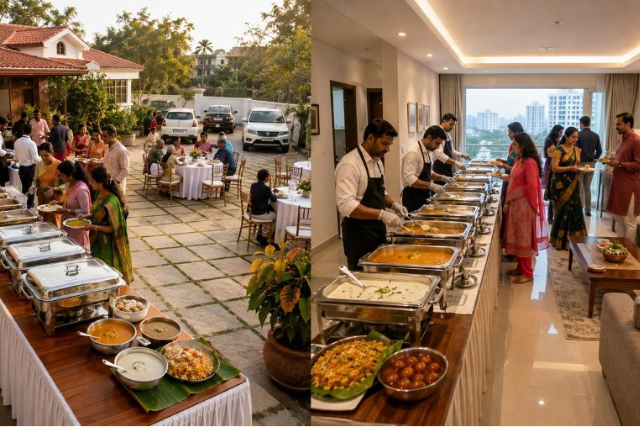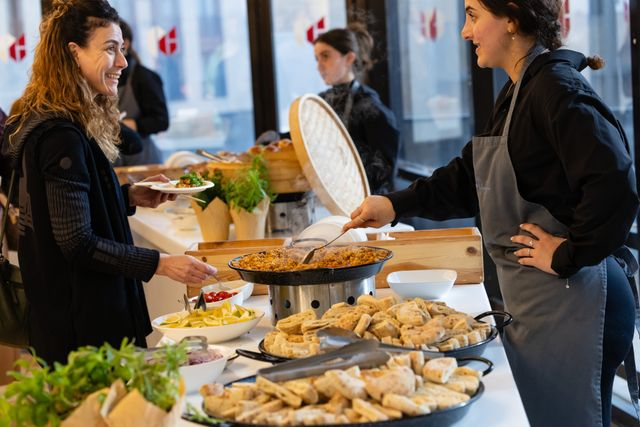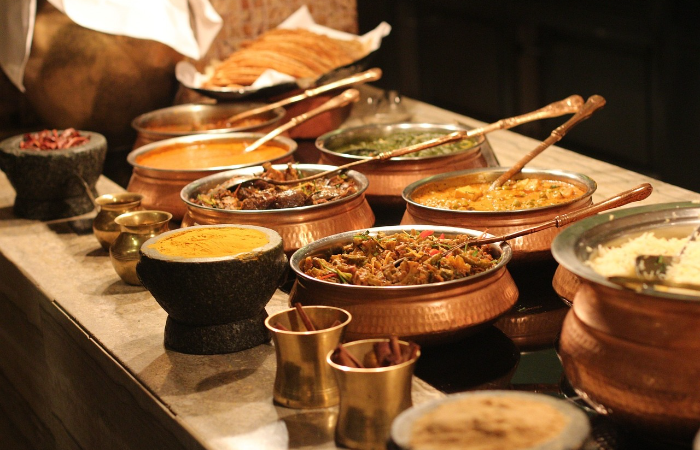

Corporate catering in Bangalore isn’t just about feeding your team—it’s about stimulating productivity and showing your company’s values. Research shows that well-nourished employees are 23% more productive and take 27% fewer sick days. There’s another reason to think over: sustainability. With over 4 tonnes of food ending up as landfill each year, the environmental effect of our catering choices cannot be ignored.
You might be planning team lunches, workshops, conferences, or product launches. Choosing corporate catering services in Bangalore that prioritise environmentally responsible methods benefits the planet and your bottom line. We’ve identified eight sustainable methods that corporate catering companies in Bangalore can help you implement.
1. Source Local and Seasonal Produce

What Local and Seasonal Sourcing Means?
Local sourcing refers to getting ingredients from suppliers within a defined geographic area. The United States Department of Agriculture uses a 400-mile radius as a general guideline, but most practical applications in corporate catering services in Bangalore work within a much tighter radius of 100 to 150 miles. This proximity allows food to reach your plate within 24 hours of harvest, compared to the weeks-long trip of imported goods.
Seasonal sourcing takes this concept further by arranging ingredient selection with natural growing cycles. Corporate catering companies in Bangalore that source seasonally select produce grown and consumed in the same climatic zone without high energy use for climate modification such as cold storage and heated glasshouses. The difference matters: local produce might still require energy-intensive storage to extend availability, but seasonal choices eliminate these artificial interventions.
Short supply chains often accompany local sourcing, with no more than one intermediary between farmer and consumer. Corporate catering services that buy from local farms create the shortest possible supply chain and maximise freshness and transparency in the food system.
Environmental and Economic Benefits
The environmental case for local seasonal sourcing centres on reduced transportation emissions. Food sourced from local areas travels about 50 miles to reach its destination. This stands in stark contrast to the 1,500 miles or more for counterparts sourced from around the world. This reduction in food miles translates to lower carbon emissions. Research indicates that food grown in the area creates 5 to 17 times less CO2 than food distributed through national wholesale channels. The shorter transport distances also reduce the need for extensive packaging and refrigeration, which further diminishes the environmental effect.
The economic benefits strengthen local communities and go beyond environmental gains. For every dollar spent on products sourced from the area, roughly 68 cents remain in the local community, compared to only 43 cents from non-local purchases. The circulation effect extends beyond the initial transaction: each dollar paid to a local supplier generates an additional INR 151.88 in economic activity. This multiplier effect creates jobs not just on farms but throughout the supply chain in processing, packaging, distribution and logistics.
Quality improvements represent another advantage. Food transported over long distances gets harvested early to withstand travel and storage time. This leads to losses in both taste and quality. Ingredients sourced from the area are harvested at peak ripeness, which preserves nutritional value and flavour. Studies show that 73% of consumers notice a taste difference in local foods, and this translates to higher satisfaction rates amongst your employees and event attendees.
How Can Bangalore Companies Implement This Practice?
Start by identifying what crops and products are unique to Karnataka and currently in season. Research which vendors can connect you to regionally sourced, sustainably grown ingredients. Distribution presents a major barrier: most farms cannot deliver to corporate offices, and companies cannot manage the logistics of purchasing from numerous small farms. Look for organised networks or food hubs that can satisfy your need for regional procurement.
Develop clear local food sourcing goals with specific criteria and timelines. Set measurable targets such as a percentage of food budget spent on local produce or a specific rupee value invested in Karnataka agriculture. These goals should match your company’s broader initiatives and reflect local seasonal availability to ensure strategies remain achievable throughout the year.
Ask potential partners about their local sourcing practices when evaluating corporate catering in Bangalore. Request information about their supplier relationships, typical sourcing radius, and seasonal menu adaptations. Transparency in supply chains allows you to verify claims and ensure your sustainability objectives are met.
Think about starting with high-impact categories like fresh produce, dairy products, and proteins where local sourcing delivers the most noticeable quality improvements. Track your progress in both rupees spent and kilogrammes of local food purchased. This makes it easier to communicate success and strengthen partnerships with suppliers over time.
2. Reduce Food Waste Through Strategic Planning

Understanding Corporate Food Waste
Food waste represents 8-12% of total food spend in commercial kitchens. This creates both environmental and financial consequences for Bangalore organisations. Surplus food ends up in landfills, where it decomposes and releases methane. This greenhouse gas is 28 times more potent than carbon dioxide. The issue extends beyond kitchens: almost 40% of all food produced globally falls to food loss or waste. This equates to over 2.5 billion tonnes annually. Food loss and waste contribute to 8-10% of greenhouse gas emissions worldwide.
Corporate catering settings see waste originate from four distinct sources. Overproduction and overordering lead to uneaten prepared food, especially when bulk purchasing and fixed production schedules fail to match actual demand. Plate waste accounts for roughly 70% of total waste. This occurs when employees take more than they can consume. Spoilage and expiration arise from poor inventory rotation and overstocking perishables. Meeting and event leftovers create periodic spikes, as companies tend to overorder catered meals to avoid shortages.
Research shows 66% of kitchen food waste is pre-consumer, whilst 34% is post-consumer. Commercial kitchens see core contributors that include preparation residue from unskilled trimming processes and overproduction that exceeds customer demand. The cost implications are substantial: food waste in the hospitality sector was estimated at £2.5 billion in 2011. Restaurants, pubs and hotels accounted for 54% of this financial cost.
Practical Waste Reduction Strategies
Prevention stands as the most effective approach to reducing food waste. Measurement forms the foundation: you cannot manage what you do not measure. A detailed food waste audit over two weeks provides baseline data needed to identify problems and track improvement. Document waste by category and separate pre-consumer waste like spoilage and preparation waste from post-consumer plate waste. Companies often find that just 20% of menu items account for 80% of waste.
Evidence-based ordering based on actual consumption patterns rather than assumptions reduces overproduction substantially. FIFO (first-in, first-out) inventory rotation works when you label all items with receive dates. This ensures older stock gets used before newer deliveries. Ordering smaller quantities more frequently may increase per-unit costs slightly, but the reduction in spoilage delivers net savings typically.
Portion flexibility equips employees to take only what they will consume. Small, regular and large portions for main dishes can reduce plate waste by 20-30%. Menu design around ingredients that can be used in multiple dishes reduces spoilage risk. Delegates must RSVP for meals at events and meetings. Historical data from previous events minimises over-ordering. Many caterers build in a ‘buffer’ of additional portions, especially at larger events and buffets. Strategic planning allows you to estimate down on guest counts safely given that most meetings include absentees.
Companies that invest in waste reduction programmes can see up to a 14-fold return on their investment. IKEA reduced food waste by 54% in all its restaurants. This saved more than 20 million meals and avoided 36,000 tonnes of greenhouse gas emissions annually, whilst saving INR 3122.08 million. Danone achieved nearly 20% reduction in food waste in its global operations compared to a 2020 baseline.
Partnering with Food Donation Organisations
Redistributing surplus food presents the next preferred option after prevention. No Food Waste operates as a food recovery network in Bangalore that connects individuals and businesses with excess food to people in need. The organisation uses technology to provide on-demand services and deliver data analytics. This makes surplus food management scalable and efficient.
The India Food Banking Network (IFBN) connects surplus inventory of packaged food and grains from food companies to feed those in need. Feeding India and Akshaya Patra also facilitate food redistribution in Indian cities. These partnerships address food insecurity whilst diverting edible food from landfills. Your business can save on waste disposal costs when you donate surplus food. This affects staff morale positively, reduces the volume of food in landfill and helps achieve environmental targets. Food can be donated after a ‘best before’ date if stored properly and not damaged, deteriorated or perished. Food past a ‘use by’ date cannot be donated for safety reasons.
3. Incorporate Plant-Based Menu Options

The Environmental Impact of Meat Consumption
Animal agriculture shapes our planet’s future in ways that extend way beyond the dinner plate. Food systems account for 21-37% of all greenhouse gas emissions globally. Cattle products alone are responsible for 52% of these emissions. The scale becomes clearer when we get into resource consumption: producing 1 kilogramme of beef requires approximately 43,000 litres of water, while 1 kilogramme of grain needs only 1,000 litres. A single beef burger patty demands 2,250 litres of water compared to just 158 litres for a soya patty.
Land use presents another critical concern. Almost 80% of all agricultural land serves livestock grazing and animal feed crop production. Yet meat and dairy provide merely 18% of global calorie supply and 37% of total protein supply. Animal agriculture drives deforestation, biodiversity loss, and species extinction as natural ecosystems get converted to pasturelands and croplands. The destruction of habitats for agricultural expansion represents the single largest factor causing species to face extinction threats.
Benefits of Plant-Based Corporate Catering
A move towards plant-based options in corporate catering services delivers substantial environmental gains. Plant-based diets can reduce diet-related land use by 76%, greenhouse gas emissions by 49%, and water use by 21% and 14% for green and blue water respectively. Research shows that meat-based meals generate 14 times higher environmental impact than vegan meals. Even vegetarian meals produce 3 times higher impact than plant-based alternatives.
Plant-based corporate catering in Bangalore supports broader business objectives beyond environmental benefits. Companies that want to reduce their carbon footprint find that vegan diets can cut food-related emissions by 50%. Health advantages accompany these environmental gains. Studies estimate that up to 19-63% of deaths and 10-39% of cancers could be prevented over 20 years through adherence to plant-rich dietary patterns. Plant-based menu items appeal to a wider market including vegans, vegetarians, flexitarians, and health-conscious employees. This makes corporate catering services more inclusive for workshops, conferences, and team events.
Creating Balanced Vegetarian and Vegan Menus
Corporate catering companies in Bangalore must move beyond the outdated assumption that vegetarian options mean serving salads. Balanced plant-based meals just need thoughtful protein inclusion through ingredients like lentils, chickpeas, beans, tofu, tempeh, or quinoa. To name just one example, replacing chicken in a stir-fry with tofu while maintaining the same sauces and sides creates a satisfying alternative without compromising flavour.
Menu planning should take nutritional completeness into account. Make sure meals contain vitamin C sources such as peppers, broccoli, or citrus fruits to boost iron absorption from plant foods. Feature legumes as the main protein source in most meals, supplemented with soya mince, tofu, and textured vegetable protein for variety. The misconception that plant-based options cost less overlooks the research, development, and labour required to create properly balanced dishes.
Plant-based options shouldn’t be afterthoughts for corporate events and product launches. They deserve equal positioning as indulgent, flavourful choices with additional health and environmental benefits. Creating diverse menus that serve various dietary needs while maintaining quality will give all team members a sense of value, whether at daily office lunches or large-scale conferences. Many corporate catering services now recognise that 93% of people purchasing plant-based burgers are meat eaters actually. This shows the broad appeal of well-executed vegetarian and vegan dishes.
4. Choose Eco-Friendly Packaging and Serviceware

The Problem with Single-Use Plastics
Takeaway packaging now makes up much of municipal waste. Cities like Berlin see 40% of waste from public spaces come from this source. The scale becomes alarming when we get into global production: approximately 36% of all plastics produced worldwide serve single-use purposes. By 2015, 79% of all plastic that ever spread ended up in landfill or polluting natural environments. The industry projects plastic growth that would consume an estimated 19% of the entire remaining global carbon budget.
The UK alone uses approximately 2.5 billion disposable coffee cups each year. That translates to 7 million cups discarded every single day. Most disposable cups contain plastic lining that cannot be recycled. Many lids are recyclable, but only 1% of these cups actually get recycled. These statistics highlight the urgent need to rethink packaging choices for team lunches, workshops, conferences and product launches in corporate catering across Bangalore.
Sustainable Packaging Alternatives
Plant-based materials are a great way to get viable alternatives to conventional plastics. Bagasse containers made from sugarcane pulp, bamboo-based packaging and rice husk products are biodegradable and compostable. Rice husk is a byproduct of rice farming. It’s low cost, renewable and has bio-absorbent properties that absorb pollutants from surrounding environments. Kraft paper manufactured from recycled materials provides sturdy, fully biodegradable options for various food items.
Cellulose packaging sourced from plant-based materials like wood pulp offers another biodegradable solution. Corporate catering services across Bangalore can source these materials from manufacturers like Greendot Biopak in India. The company produces 100% compostable bags, food-grade packaging, cutlery and crockery. Everything from grocery bags to hot liquid bags and compostable films is available, all engineered to uphold food safety standards while minimising ecological footprints.
Implementing Reusable Systems
Reusable systems deliver the most influential reduction in environmental impact. Research shows that reusable cups just need 2-10 uses to break even when washed on-site with a dishwasher. Success depends on efficient sanitising processes and frequent reuse throughout each item’s lifespan.
Cities worldwide have showed the effectiveness of reusable systems at events. Munich’s Oktoberfest banned all disposable dishware and cutlery in 1991. The festival mandated exclusive use of reusable alternatives, resulting in a two-thirds reduction in cleaning and waste disposal within 15 years. Corporate catering companies across Bangalore can implement similar systems by defaulting to china or reusable containers and keeping disposables behind counters where customers must request them. Think over deposit schemes where customers pay a small refundable amount for reusable containers at events and product launches. Freiburg charges €1 for reusable coffee cups returnable to any participating café.
Education remains critical to work. Clear sanitary protocols for reusable foodware address both actual safety and public perception, while training staff on proper recycling procedures ensures your efforts achieve intended results.
5. Partner with Sustainable Corporate Catering Services in Bangalore

What Makes a Caterer Sustainable
You need to look beyond marketing buzzwords and get into actual practices to find genuine sustainable corporate catering services in Bangalore. Sustainable caterers think over every aspect of food preparation and its environmental effect. This includes ingredient selection, preparation methods, packaging and waste management. The difference lies in how they approach sourcing, energy consumption, supply chain transparency and waste handling.
Sustainable corporate catering companies in Bangalore put quality raw materials first when selecting ingredients. They show concern about animal treatment and choose suppliers based on proximity. Menus vary depending on the time of year. Seasonal produce gets incorporated to reduce resources needed for transport. They also implement detailed waste reduction strategies. Leftovers from events get donated and sustainable serving utensils replace disposable alternatives. Energy-efficient equipment forms another lifeblood. Low consumption equipment delivers high efficiency and reduces environmental impact at the same time.
Key Certifications and Standards to Look For
Third-party certifications verify that sustainability claims match reality. The Green Restaurant Association’s standards reflect over 30 years of research in restaurants and the environment. The Association verifies environmental practices of their Certified Green Caterers. These caterers earn GreenPoints based on performance in categories like energy use, waste, chemicals and pollution. The Food Made Good Standard represents the only global sustainability certification designed especially for the foodservice industry. More than 10,500 kitchens across 73 countries have earned this accreditation.
The Coolfood Pledge offers another credible measure. Participating organisations must reduce food-related greenhouse gas emissions by 25% by 2030. Look for Fair Trade Certified licences for supply chain ethics. These ensure products are grown, harvested, manufactured and traded in ways that improve livelihoods and protect the environment. The Food Alliance Certification ensures safe and fair working conditions, humane animal treatment and careful stewardship of ecosystems.
Questions to Ask Potential Catering Partners
Ask specific questions about sourcing relationships, waste management procedures and environmental certifications when evaluating corporate catering in Bangalore for your team lunches, workshops, conferences or product launches. Request details about their typical sourcing radius and seasonal menu adaptations. Ask whether they use compostable plates, how they manage leftovers and what happens to unused food. Ask about their experience with outdoor and large events too. Sustainability logistics become harder with bigger guest counts. Budget transparency matters. Green service should be clearly costed without hidden eco-fees. Caterers who have been practising sustainable sourcing for decades have refined their processes and built strong relationships with local producers. This ensures consistent access to high-quality ingredients for your corporate events.
6. Implement Energy-Efficient Kitchen Operations
Energy Consumption in Corporate Catering
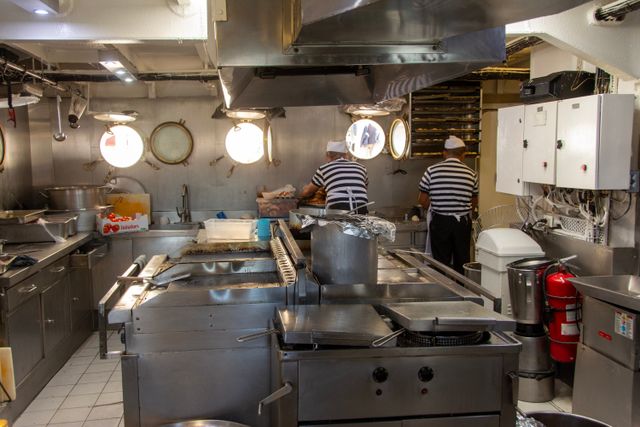
Kitchen operations drive a disproportionate share of energy costs in the catering industry. Restaurants use five to seven times more energy per square foot than other commercial buildings. High-volume operations consume up to 10 times more. The kitchen accounts for as much as 25% of total energy consumption, so corporate catering services in Bangalore that handle team lunches, workshops, conferences and product launches need to scrutinise where and how this energy gets consumed.
The breakdown reveals specific opportunities for intervention. Refrigeration claims the largest portion of electricity consumption, followed by lighting and cooling systems. Foodservice warewashers consume substantial electricity for heating wash water, while appliances like refrigerators, freezers and chest freezers run all the time and create ongoing electricity demand. Air intake systems present another challenge. They often run from early morning until late at night because kitchen staff lack proper training on optimal settings.
Energy-Saving Equipment and Practices
Upgrading to ENERGY STAR certified commercial food service equipment can cut kitchen utility costs without sacrificing features, quality or performance. These energy-efficient products deliver savings of 10 to 70 percent over standard models, depending upon the product category. Refrigeration units with modern, efficient equipment rated energy efficiency class A or B reduce consumption and maintain temperature stability. On top of that, certified dishwashers, ice machines and steam cookers save water and help operators lower both water and sewer bills.
Lighting represents about 13 percent of total energy breakdown in restaurants. This makes it an available starting point for efficiency upgrades. ENERGY STAR certified LEDs use 90 percent less energy than traditional lighting and have longer lifespans that reduce replacement frequency. Smart or automatic air vent systems analyse ventilation requirements using sensors to determine air humidity and CO2 content. They adjust air exchange so the system doesn’t run at maximum power all the time.
Operational practices matter just as much. Regular maintenance ensures equipment operates at peak efficiency. Annual HVAC tune-ups improve performance similarly to how car tune-ups improve fuel economy. Turn off lights and appliances when not in use and reduce idle time for cooking equipment to prevent unnecessary energy consumption. When you select equipment for corporate catering in Bangalore, think over renewable energy options that further reduce environmental impact.
Working with Caterers Who Prioritise Efficiency
When you evaluate corporate catering companies in Bangalore, ask specific questions about their kitchen operations and equipment standards. Request information about their energy management systems, equipment age and maintenance schedules. Caterers committed to efficiency invest in modern cooking equipment where acquisition costs pay for themselves through much lower energy consumption. They check door seals often, use lids on pans to retain heat and avoid premature preheating. Partner with caterers who demonstrate measurable energy efficiency for your team lunches, events and conferences. This reduces environmental impact and often translates to better pricing through their lower operational costs.
7. Support Ethical and Transparent Supply Chains

Why Supply Chain Transparency Matters
Consumer expectations have moved in recent years. According to research, 65% of shoppers would switch from their usual brand to another that communicates more openly about its supply chain. This statistic matters for corporate catering in Bangalore serving team lunches, workshops, conferences and product launches. Your employees and clients care more about where their food comes from and how it reaches their plates.
Supply chain transparency means disclosing verifiable information about the origins, processes and ethical practises behind the ingredients used by corporate catering services. Caterers must know every step ingredients take from farm to fork. Research shows that consumers are four times more likely to trust companies that are purpose-driven and communicate production conditions. 72% of shoppers think transparency is very important or important at the time of making food choices.
Fair Trade and Ethical Sourcing Practices
Ethical sourcing focuses on the effect of ingredient production on people and the planet. Fair Trade certification makes sure farmers are paid fairly and that products are grown, harvested and traded in ways that improve livelihoods while protecting the environment. Corporate catering companies in Bangalore must work with suppliers who prioritise fair wages, humane farming practices and minimal environmental footprints.
Ethical practices extend beyond fair compensation. They include safe working conditions, environmental responsibility and transparency at every production stage. Then, corporate catering services committed to ethical sourcing verify that their suppliers abide by codes of conduct covering human rights, local pollution, waste management and resource efficiency.
Verifying Your Caterer’s Supply Chain
Ask potential partners specific questions about their supply chain practices when evaluating corporate catering in Bangalore. Request information about supplier relationships, traceability systems and certifications they hold. Look for credentials like Fair Trade, Rainforest Alliance or equivalent local certifications that verify responsible practices. Develop evaluation criteria to examine environmental effect, labour practices, animal welfare standards and community involvement. Corporate catering services with transparent supply chains can trace products back to their source and demonstrate genuine commitment rather than superficial marketing claims.
8. Measure and Communicate Your Sustainability Impact

Setting Measurable Sustainability Goals
You can’t implement environmentally responsible methods without measurement. Run a catering audit first. Identify your biggest sustainability risks: delivery frequency, packaging materials that end up in general waste, weekly food waste volumes, and your caterer’s visibility into sourcing and emissions strategy. A baseline makes improvement measurable and concrete.
Define what success looks like for your corporate catering in Bangalore. Set realistic goals that match your team’s values, such as including catering in your overall sustainability strategy, setting a Net Zero target, using more locally sourced ingredients, cutting food waste by a set percentage, or switching to reusable packaging. Net Zero means reducing greenhouse gas emissions as much as possible and then balancing whatever remains by removing the same amount from the atmosphere.
Tracking and Reporting Progress
Work with corporate catering services in Bangalore that share real data, not slogans. Look for those who involve suppliers in emissions tracking, experiment with ways to reduce their footprint from kitchen to waste, and communicate openly about challenges. Sustainability is becoming a core part of long-term operational strategy. Employees, investors and clients expect organisations to demonstrate environmental responsibility.
Engaging Employees in Sustainability Efforts
Nearly 50% of organisations identify lack of participation as their biggest sustainability challenge. Employees want to work for companies that match their values increasingly. Communicate metrics and progress on sustainability initiatives to keep everyone informed about what you’ve done, what needs doing, and constraints you face. Performance management indicators connected to sustainability motivate employees to advance goals. This transforms corporate catering from a compliance exercise into a shared organisational value for your team lunches, workshops, conferences and product launches.
Comparison of Environmentally Responsible Corporate Catering Practices for Bangalore Companies
|
Practise |
Key Environmental/Business Benefit | Biggest Problem/Consideration | Implementation Approach |
Measurable Effect |
| Source Local and Seasonal Produce | Locally sourced food creates 5 to 17 times less CO₂ than nationally distributed food; 68 pence of every pound spent remains in local community vs 43 pence for non-local purchases | Distribution logistics – most farms cannot deliver directly to corporate offices | Identify Karnataka seasonal crops and develop clear sourcing goals with specific targets. Partner with food hubs or organised networks. Start with high-effect categories like fresh produce and dairy | Local food travels about 50 miles vs 1,500+ miles for globally sourced items; each rupee generates additional ₹151.88 in economic activity |
| Reduce Food Waste Through Strategic Planning | Food waste represents 8-12% of total food spend; companies can see up to 14-fold return on investment in waste reduction programmes | 66% of kitchen waste is pre-consumer whilst 34% is post-consumer; plate waste accounts for roughly 70% of total waste | Conduct two-week food waste audit and implement data-driven ordering. Use FIFO inventory rotation. Offer portion flexibility and require RSVP for event meals | IKEA reduced food waste by 54%, saving over 20 million meals and ₹3,122.08 million; Danone achieved nearly 20% reduction compared to 2020 baseline |
| Incorporate Plant-Based Menu Options | Transitioning to plant-based diets can reduce diet-related land use by 76%, greenhouse gas emissions by 49%, and water use by 21-14%; vegan diets can cut food-related emissions by 50% | Creating balanced, appealing plant-based options requires research and development – not cheaper than meat options | Include protein sources like lentils, chickpeas, and tofu in every meal. Ensure vitamin C sources for iron absorption. Position plant-based options as indulgent choices, not afterthoughts | 1 kg beef requires 43,000 litres of water vs 1,000 litres for grain; meat-based meals generate 14 times higher environmental effect than vegan meals |
| Choose Eco-Friendly Packaging and Serviceware | Reusable cups need just 2-10 uses to break even when washed on-site; Munich’s Oktoberfest achieved two-thirds reduction in cleaning and waste disposal within 15 years | Takeaway packaging accounts for 40% of waste from public spaces; 79% of all plastic ever produced by 2015 ended up in landfill or polluting environments | Default to reusable containers and implement deposit schemes for events. Source plant-based alternatives like bagasse or rice husk packaging. Establish clear sanitary protocols | 2.5 billion disposable coffee cups used in UK (7 million daily); only 1% get recycled despite recyclable lids |
| Partner with Environmentally Responsible Corporate Catering Services | Environmentally responsible caterers reduce environmental effect throughout the entire food preparation process whilst often offering better pricing through lower operational costs | Distinguishing genuine sustainability from marketing buzzwords requires verification of actual practices | Ask specific questions about sourcing radius, seasonal menus, and waste management. Look for Green Restaurant Association or Food Made Good Standard certification | Over 10,500 kitchens in 73 countries have earned Food Made Good Standard certification; Coolfood Pledge requires 25% reduction in food-related emissions by 2030 |
| Implement Energy-Efficient Kitchen Operations | ENERGY STAR certified equipment delivers savings of 10-70% over standard models; kitchen accounts for 25% of total energy consumption | Restaurants use 5-7 times more energy per square foot than other commercial buildings; high-volume operations consume up to 10 times more | Upgrade to ENERGY STAR certified equipment and switch to LED lighting (90% less energy). Implement smart ventilation systems. Establish regular maintenance schedules | Refrigeration claims the largest portion of electricity; lighting represents 13% of total energy breakdown; LEDs use 90% less energy than traditional lighting |
| Support Ethical and Transparent Supply Chains | 65% of shoppers would switch brands for more supply chain transparency; consumers are 4 times more likely to trust purpose-driven companies | Requires complete traceability from farm to fork for all ingredients and suppliers | Request supplier relationship details and verify Fair Trade or equivalent certifications. Develop evaluation criteria covering environmental impact and labour practices | 72% of shoppers think about transparency as very important or important when making food choices |
| Measure and Communicate Your Sustainability Effect | Nearly 50% of organisations identify lack of engagement as their biggest sustainability challenge; measurement transforms compliance into shared organisational value | Requires baseline data through catering audits before improvement can be measured | Run catering audit identifying delivery frequency, packaging waste, and food waste volumes. Set realistic goals like Net Zero targets or specific waste reduction percentages. Track progress with suppliers | Performance management indicators connected to sustainability motivate employees to advance goals; employees want to work for companies that line up with their values |
This detailed comparison demonstrates how Bangalore companies can implement environmentally responsible corporate catering practices for team lunches, workshops, conferences, product launches, and other corporate events. Each practice offers distinct environmental and business benefits whilst requiring specific implementation strategies tailored to your organisation’s needs and capabilities. The measurable effects provide clear ways to measure progress and communicate success to employees, clients, and stakeholders.
Key Takeaways
Sustainable corporate catering isn’t just environmentally responsible—it’s financially smart. Companies implementing waste reduction programmes can see up to a 14-fold return on investment, whilst well-nourished employees are 23% more productive and take 27% fewer sick days.
- Local sourcing cuts emissions dramatically: Locally sourced food creates 5-17 times less CO₂ than nationally distributed alternatives, with food travelling just 50 miles versus 1,500+ miles for global counterparts.
- Plant-based menus reduce environmental impact significantly: Transitioning to plant-based options can slash diet-related land use by 76% and greenhouse gas emissions by 49%, with meat-based meals generating 14 times higher environmental impact than vegan alternatives.
- Strategic waste reduction delivers substantial savings: Food waste represents 8-12% of total food spend in commercial kitchens, but companies like IKEA have reduced waste by 54%, saving over ₹3,122 million annually through proper planning and measurement.
- Reusable systems outperform disposables quickly: Reusable cups break even environmentally after just 2-10 uses when washed on-site, whilst 79% of all plastic ever produced has ended up in landfills or polluting natural environments.
- Energy-efficient equipment pays for itself: ENERGY STAR certified kitchen equipment delivers 10-70% savings over standard models, with restaurants using 5-7 times more energy per square foot than other commercial buildings.
Start with practices that align with your company’s priorities—whether reducing food waste, incorporating plant-based options, or partnering with certified sustainable caterers. Track progress with specific metrics, and remember that each sustainable choice for your team lunches, workshops, and conferences contributes to both environmental health and your bottom line.
Conclusion
You don’t need to overhaul everything at once to implement green corporate catering for your Bangalore office. Start with one or two practises that match your company’s priorities. This could mean reducing food waste through better planning or incorporating more plant-based options into your team lunches and events. The eight practises we’ve covered deliver measurable environmental benefits and support your bottom line through reduced waste, lower energy costs, and improved employee satisfaction. Track your progress with specific metrics. Then gradually expand your sustainability efforts as you build momentum. Your choice of corporate catering partner matters substantially. Look for services that demonstrate commitment through certifications, transparent supply chains, and measurable impact rather than just sustainability marketing. Each green choice you make for your workshops and conferences contributes to a healthier planet and a stronger local economy.
FAQs
Q1. How can Bangalore companies reduce food waste in their corporate catering?
Companies can reduce food waste by conducting a comprehensive two-week audit to identify problem areas, implementing data-driven ordering based on actual consumption patterns, using FIFO inventory rotation, offering flexible portion sizes, and requiring RSVPs for catered events. Additionally, partnering with food donation organisations like No Food Waste or the India Food Banking Network helps redistribute surplus food to those in need whilst diverting edible food from landfills.
Q2. What are the environmental benefits of sourcing local and seasonal produce for corporate events?
Locally sourced food creates 5 to 17 times less CO₂ than nationally distributed food and travels approximately 50 miles compared to 1,500+ miles for globally sourced items. This reduces transportation emissions, packaging requirements, and refrigeration needs. Additionally, 68 pence of every pound spent on local products remains in the community, generating an extra ₹151.88 in economic activity for each rupee invested.
Q3. Why should companies incorporate plant-based options in their corporate catering menus?
Plant-based diets can reduce diet-related land use by 76%, greenhouse gas emissions by 49%, and water use by 21-14%. Meat-based meals generate 14 times higher environmental impact than vegan meals, whilst producing 1 kg of beef requires 43,000 litres of water compared to just 1,000 litres for grain. Plant-based options also appeal to a wider audience including vegans, vegetarians, flexitarians, and health-conscious employees.
Q4. What sustainable packaging alternatives exist for corporate catering in Bangalore?
Sustainable alternatives include plant-based materials like bagasse containers made from sugarcane pulp, bamboo-based packaging, rice husk products, and kraft paper from recycled materials. Reusable systems offer the most impact, with reusable cups needing just 2-10 uses to break even environmentally. Companies can source compostable options from manufacturers like Greendot Biopak in India, which produces 100% compostable bags, cutlery, and food-grade packaging.
Q5. How can companies verify that their catering partner follows sustainable practices?
Look for third-party certifications such as the Green Restaurant Association’s Certified Green Caterers, Food Made Good Standard (with over 10,500 kitchens certified across 73 countries), or the Coolfood Pledge. Ask specific questions about sourcing radius, seasonal menu adaptations, waste management procedures, energy-efficient equipment, and supply chain transparency. Request details about their supplier relationships, certifications, and measurable sustainability metrics.